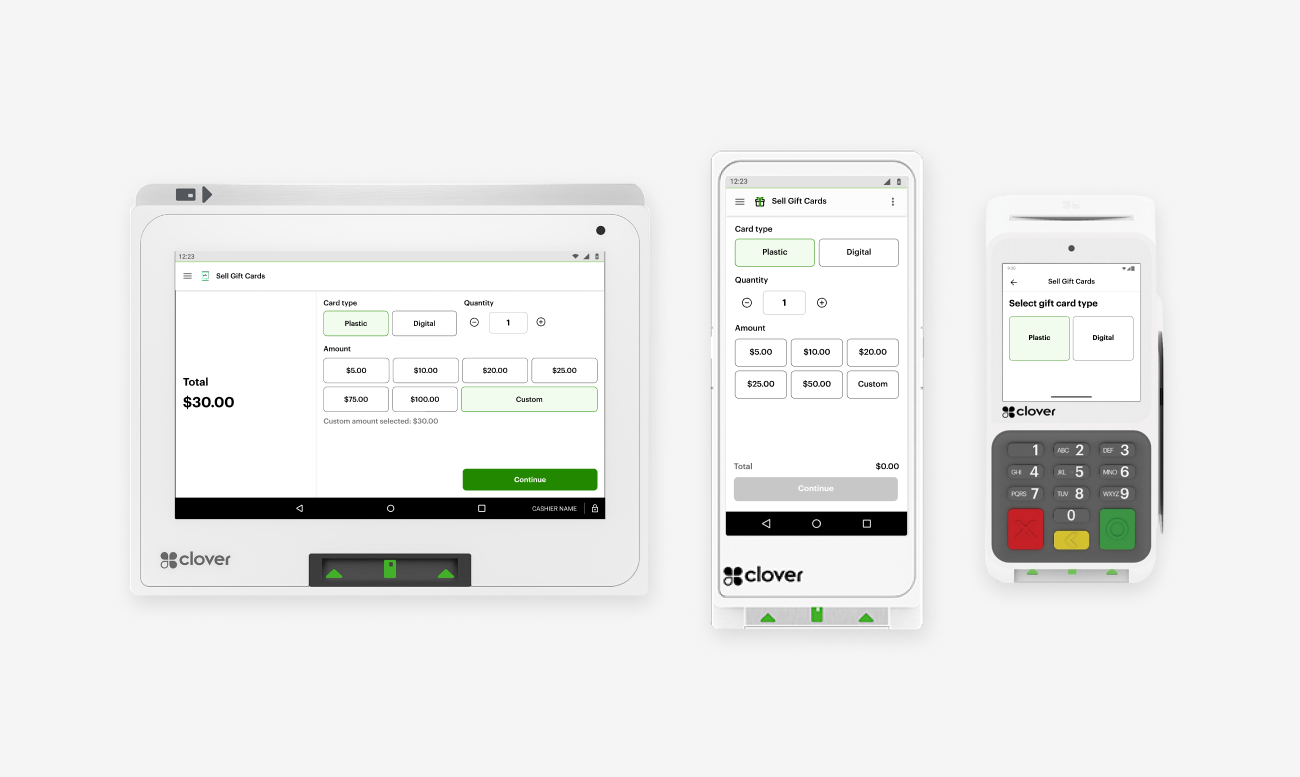
Refining a legacy gift card app into a device-first experience across the Clover POS ecosystem.
Context
The Clover Gift Cards management app was a legacy product that hadn't been updated in years, unable to keep up with changing demands and needs. As part of a major inititiative to transition the outdated experience into a native Clover application, I led a 7-week redesign of the entire app. This project also served as a pilot program testing the implementation of a new design system across three device types.
Problem
The Clover Gift Cards app was a decade-old legacy system that had become a bottleneck for both merchants and developers. As the hardware evolved, the software remained stagnant, resulting in two critical issues:
- Systemic Fragmentation: A lack of unified design standards meant the interface varied wildly across Mini, Flex, and Compact devices, creating significant maintenance overhead and a disjointed brand experience across the device experience.
- Hardware-Software Mismatch: The app relied on "desktop-first" interactions—such as small tabs and dense text links—that failed to meet the ergonomic needs of a high-pressure, touch-based merchant environment.
Learning the lay of the land
Coming into the project, I was new to designing for POS devices. I had to quickly bridge the knowledge gap on the device ecosystem and understand the entire app experience.
- Resourcefulness over readiness: While waiting for my own set of devices to be delivered to me, I started by borrowing devices from coworkers. Although it seemed like a setback, having access to multiple devices on the same models allowed me to see how different Clover plans and hardware constraints dynamically change which buttons or features appear.
- Audit & Heuristic Evaluation: I conducted a high-level audit to identify design system gaps and a heuristic evaluation to uncover usability issues.
Heuristic evaluation conducted using Nielsen Norman Group's Usability Heuristics.
From desktop to device thinking
The turning point of the project was moving away from "web-based" mentalities and focusing on designing for the hand, not for the mouse.
- Initial wireframes used standard radio buttons, but after receiving feedback from a teammate, I pivoted to Radio Tiles. These provide much larger touchpoints, which are essential for busy merchants who need to tap accurately and quickly in a fast-paced retail environment.

Focused task completion
Removing visuals that added little value and clear steps created a more focused workflow for merchants.

Prioritizing consistency usability on all devices
Clover's Compact device has the smallest footprint, much shorter than the height of the average mobile phone. I separated information into more focused, sequential screens—prioritizing "one-task-per-screen" to maintain usability.
.png)
Validating designs
To ensure the new design system and redesigns didn't disrupt merchant workflows, I created unmoderated task flows to test with 15 participants (5 per device type).
The feedback was overwhelmingly positive. Participants navigated the flows with ease, proving that the new design system was a viable foundation for the rest of the Clover ecosystem.
.png)
Fueling future initiatives
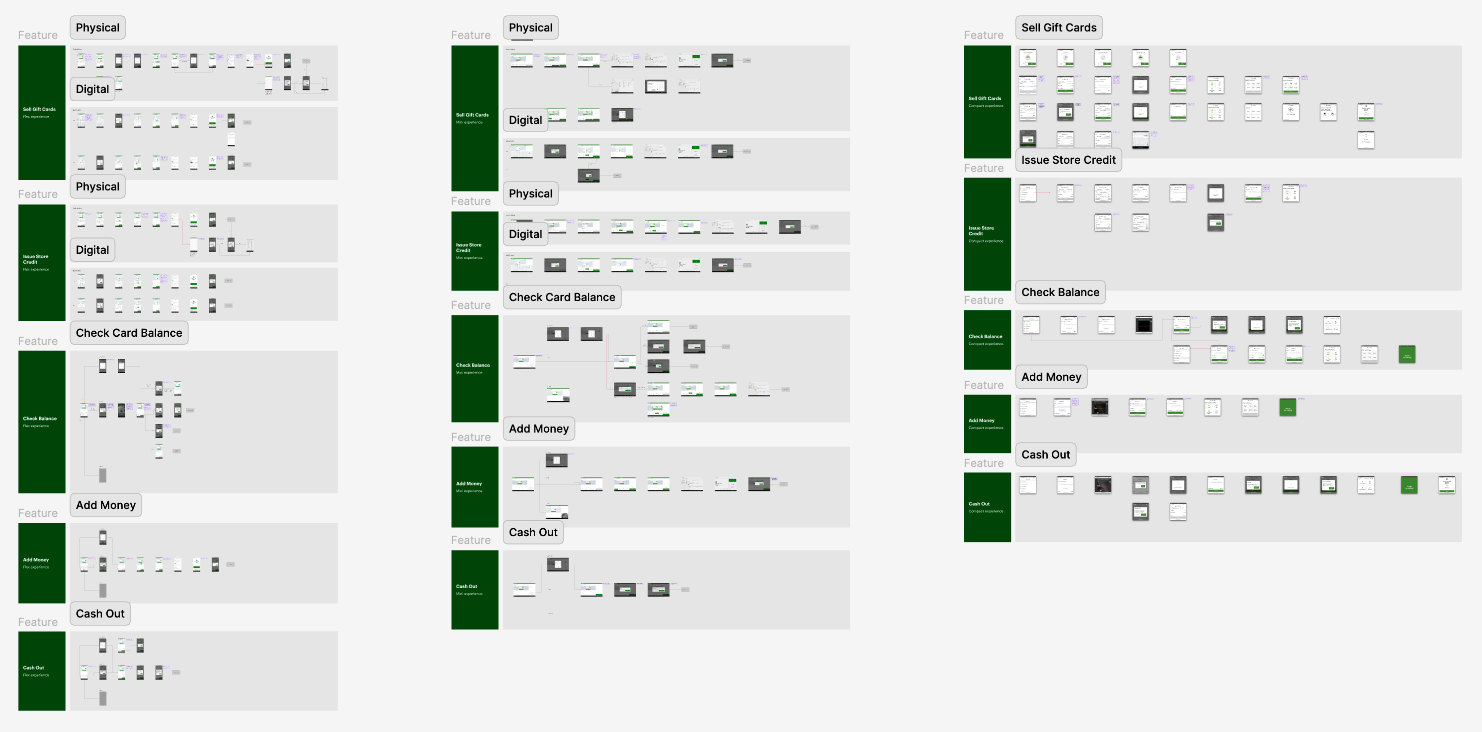
This project successfully validated the Compact Android Library as the new standard for Clover. By mapping out nearly 300 total screens across three devices, I provided a blueprint for engineering that is currently being applied to future Clover app refreshes.

Reflections
This project was an exercise in leadership, adaptability in a new environment with changing requirements, and shifting design thinking.
- Designing for the hand, not for the mouse. Mouse (few pixels) → Finger ( ~1 inch = ~96 pixels). Sitting down, focused tasks → moving around the store, multi-tasking orders. Likely more error prone.
- Own Your Research: I learned to rely on primary research rather than secondary screenshots received from other sources, which can often hide blind spots in the user journey.
- Leverage Local SMEs: As a newcomer to POS, leaning on the Subject Matter Experts and leveraging the devices available to me was the fastest way to master the ecosystem.

